How does night shift work affect employee wellbeing?
In Philippine BPOs and call centers, night work makes good sleep harder for many employees, and poor sleep affects how people feel and function. Employers cannot remove night shifts from a business that serves other time zones, but they can make schedules more predictable, make rest easier, and make support reachable during the hours people actually work.
This guide is for HR and operations leaders in business process outsourcing (BPO) and shared services in the Philippines. It is general information, not medical or legal advice.
What research says about night shift work and health
Sleep is the most consistently reported problem. A 2019 consensus paper by the Working Time Society, published in Industrial Health, found that most shift workers report shorter and poorer sleep, and that sleep is most disturbed on night and rotating schedules. The paper attributes this to a mismatch between working hours and the body clock, to restricted sleep, or to both.
Philippine sources point the same way. An International Labour Organization book published in 2010, Offshoring and Working Conditions in Remote Work, included a survey of Philippine BPO employees in which insomnia and fatigue were common complaints. A 2024 integrative review of workplace health promotion in the Philippine BPO sector, published in Public Health in Practice, drew on 37 sources, including studies, reports and news articles, and listed sleep disturbances and fatigue among the commonly reported concerns.
The evidence on mental health is less settled. The same consensus paper says there is less consistent evidence linking shift work to mental health problems. It is reasonable to start with sleep, and to pay attention to stress and mood without assuming that night work harms everyone in the same way. Some employees adapt well to night work and prefer it.
What the law provides for night workers
These parts of Philippine labor law are directly relevant:
- Who the night work chapter covers. Republic Act No. 10151 added a chapter on night workers to the Labor Code. It applies to people employed to work at night for not less than seven consecutive hours, including the interval from midnight to 5 a.m., with exceptions such as agriculture, fishing and maritime transport (Article 154). DOLE's implementing rules set the working definition of a night worker.
- Night shift differential. Under Article 86 of the Labor Code, covered employees are paid an additional amount of not less than ten percent of their regular wage for each hour worked between 10 p.m. and 6 a.m.
- Health assessment. A night worker can ask for a free health assessment (Article 155).
- Facilities. Employers provide first-aid facilities, resting quarters and transportation, subject to DOLE rules (Article 156).
- Transfer. A worker certified unfit for night work is transferred to a similar suitable job whenever practicable (Article 157).
- Women night workers. An alternative to night work must be available to women for at least sixteen weeks around childbirth, and for further periods during pregnancy or after childbirth where a medical certificate says it is needed. Pregnant women and nursing mothers may work at night only if a physician other than the company physician certifies they are fit (Article 158).
- Consultation. Employers consult workers' representatives before introducing night work schedules (Article 161).
- Occupational safety and health. Republic Act No. 11058 requires an OSH program and an OSH committee that oversees it (Sections 12 and 13). The Act does not mention night work by name, but night-shift health and safety measures belong in that program.
In addition, employers are required to have a workplace mental health policy and program under the Mental Health Act (Republic Act No. 11036) and DOLE Department Order No. 208-20.
The article numbers above are the ones RA 10151 inserted; the Labor Code has since been renumbered, so confirm the current numbering and the details of each requirement with your legal counsel.
Practical steps for BPO employers
Make schedules predictable
- Publish schedules as far ahead as you can.
- Avoid frequent switches between day and night shifts where the business allows it.
- Set a minimum gap between shifts that allows a full sleep after the commute, and build it into workforce-management rules and shift bids.
- Ask employees and their representatives which patterns work for them. Preferences vary, and the law expects consultation before night schedules are introduced.
Make rest easier
- Check that the resting quarters RA 10151 and its DOLE rules call for are in place and usable during the night shift.
- Make sure adherence and queue targets do not penalize people for taking scheduled breaks.
- Share sleep-health information prepared or reviewed by your company physician, occupational health nurse or another qualified source.
Make support reachable at night
In our view, a workplace mental health program for a night-shift workforce should work at night too.
- Check that counseling, helplines and HR contacts are available during night-shift hours, not only office hours. An employee assistance program is one way to provide this.
- Tell employees exactly how to reach support and what happens when they do.
- If your program includes a chat-based service, make sure night-shift teams know it exists.
Equip team leaders
- Train team leaders to notice changes in a team member and to start a supportive conversation.
- Make clear that a team leader's role is to listen and point to support, not to diagnose.
- Set a rule that what a team member shares is not recorded in performance files or passed on without consent, except where someone's safety is at risk.
- Give leaders a simple referral path they can remember at 3 a.m.
- Include what to do when someone may be at immediate risk: your site's emergency procedure and the National Center for Mental Health crisis hotline (1553).
Check transport, health assessments and meals
- Check that the transport arrangements and health assessments RA 10151 and its DOLE rules call for are in place for night-shift teams.
- Make proper meals available during the shift.
Ask, then adjust
- Include night-shift teams in wellbeing surveys, and report their results separately only where the group is large enough that no individual can be identified.
- Review what support was used and when, using aggregate figures only.
- Change one thing at a time and tell employees what changed because of their feedback.
How Infinit Care can help
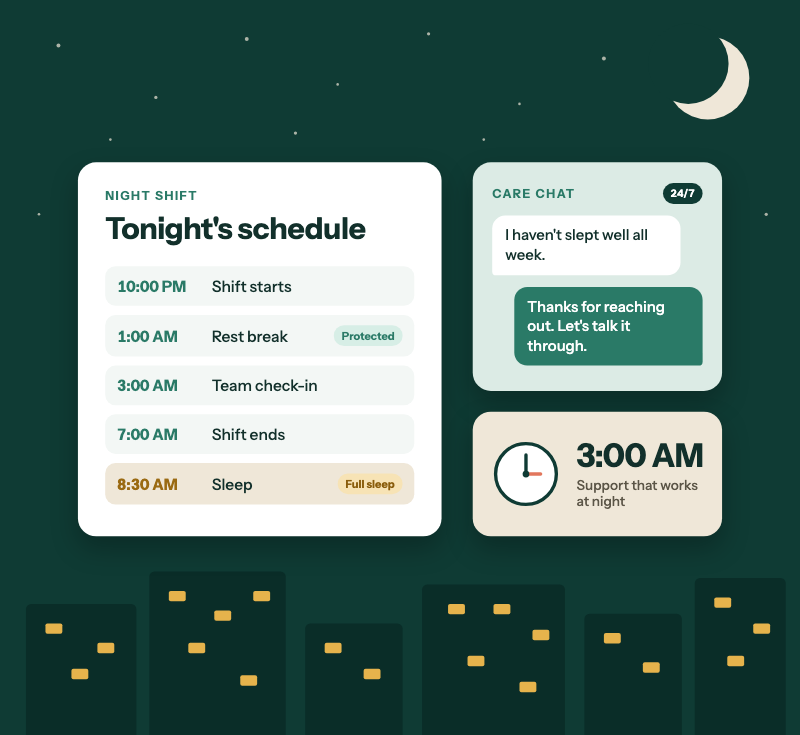
Infinit Care works with employers in the Philippines, including BPO and shared services organizations. Depending on the program, services can include counseling, coaching, wellbeing assessments, education for employees and team leaders, and Care Chat, which is available 24/7 (counseling and other appointments follow their own schedules). Where reporting is part of the program, HR receives aggregate reporting on program use and wellbeing trends rather than individual session details.
Read more about our employee mental health programs, or book a discovery call.
Frequently asked questions
Is night shift bad for mental health?
A 2019 Working Time Society consensus paper links night and rotating shifts most clearly to shorter and poorer sleep, and says the evidence connecting shift work to mental health problems is less consistent. Sleep, fatigue and stress are worth addressing, but night work does not affect everyone in the same way.
What is the night shift differential in the Philippines?
Under Article 86 of the Labor Code, covered employees are paid an additional amount of not less than ten percent of their regular wage for each hour worked between 10 p.m. and 6 a.m.
What should a BPO wellbeing program include?
For a night-shift workforce we would start with predictable scheduling, a place and time to rest, trained team leaders, support that is reachable at night, and regular feedback from night-shift teams.
Are employers required to provide mental health support to night-shift workers?
There is no separate mental health rule for night workers. The general requirement under the Mental Health Act (RA 11036) and DO 208-20 for a workplace mental health policy and program, which includes a way to reach counseling or referral, covers them. RA 10151 separately gives night workers health assessments on request and facilities.
This article is general information, not medical or legal advice.
Sources
- Moreno et al., "Working Time Society consensus statements: Evidence-based effects of shift work on physical and mental health", Industrial Health, 2019: https://pmc.ncbi.nlm.nih.gov/articles/PMC6449637
- Messenger and Ghosheh (eds.), Offshoring and Working Conditions in Remote Work, International Labour Organization, 2010, as reported by GMA News: https://www.gmanetwork.com/news/money/content/197534/ilo-many-call-center-agents-in-rp-suffer-from-insomnia-fatigue/story
- Candelario et al., integrative review of workplace health promotion in the Philippine BPO sector, Public Health in Practice, 2024: https://pmc.ncbi.nlm.nih.gov/articles/PMC10920955
- Republic Act No. 10151, An Act Allowing the Employment of Night Workers: https://elibrary.judiciary.gov.ph/thebookshelf/showdocs/2/37482
- Labor Code of the Philippines (Presidential Decree No. 442, as amended), Article 86, night shift differential
- Republic Act No. 11058, An Act Strengthening Compliance with Occupational Safety and Health Standards: https://lawphil.net/statutes/repacts/ra2018/ra_11058_2018.html
- Republic Act No. 11036, the Mental Health Act, Section 25: https://elibrary.judiciary.gov.ph/thebookshelf/showdocs/2/83255
- DOLE, Department Order No. 208-20: https://dole.gov.ph/news/do-208-20-guidelines-for-the-implementation-of-mental-health-workplace-policies-and-programs-for-the-private-sector/