EAP vs HMO: what is the difference?
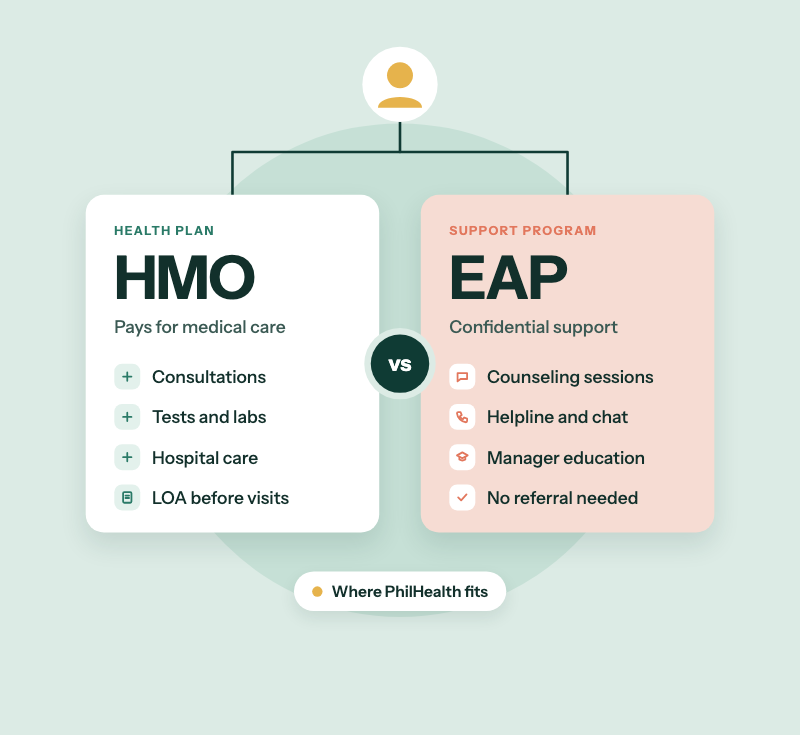
An HMO pays for medical care under a health plan. An employee assistance program (EAP) gives employees confidential access to support, such as counseling, for personal and work-related concerns. They overlap in places, but one does not replace the other, and many Philippine employers use both.
What each one covers for mental health depends on the specific plan or program.
What an HMO is for
A health maintenance organization (HMO) plan is a prepaid health benefit. The employer pays membership fees, and employees can use consultations, tests and hospital care within the plan's network and limits.
For mental health, plans differ on:
- whether, and how far, consultations and outpatient medicines are covered;
- limits on the number of sessions or the amount covered; and
- how pre-existing conditions are treated.
The only way to know is to read your plan's schedule of benefits and its exclusions, or ask your HMO account manager directly.
Employees use an HMO through its accredited providers, usually after getting a letter of authorization (LOA).
What an EAP is for
An employee assistance program is a service the employer provides so employees can get confidential professional support for personal and work-related concerns. Typical elements are counseling sessions, a helpline or chat service, and education for employees and managers.
An EAP is designed to be easy to reach early: an employee does not need a diagnosis, a referral or a letter of authorization to talk to someone. Confidentiality has the usual professional and legal limits, such as a serious risk to someone's safety; ask a provider to explain theirs.
Depending on the provider and the program, an EAP may also include coaching, wellbeing assessments, legal or financial advice, and reporting for HR on overall use.
An EAP is not health insurance. It does not pay hospital bills, and ongoing psychiatric treatment or medication is normally handled through medical channels.
What PhilHealth covers for mental health
PhilHealth introduced an outpatient mental health benefit package under PhilHealth Circular No. 2023-0018, issued in October 2023. It has two parts: general mental health services and specialty mental health services.
Under the circular, PhilHealth pays accredited providers a package rate per patient per fiscal year: ₱9,000 for general mental health services and ₱16,000 for specialty mental health services. These are amounts paid to the provider for the package, not a cash allowance for the member.
The circular makes the package available to Filipinos aged 10 and above for psychiatric cases, and at any age for neurologic cases, after assessment at a PhilHealth-accredited provider.
For employers, this means employees may be able to use this package where an accredited provider is within reach. Availability is limited by the accredited list, so check it, and PhilHealth's current circulars, before you promote the benefit to employees.
EAP vs HMO comparison table
| HMO | EAP | |
|---|---|---|
| Main purpose | Pays for medical care | Gives access to confidential support |
| Who pays | Usually the employer; dependents are often employee-paid | Usually the employer, per employee or per use |
| Who is covered | Enrolled members; dependents and non-regular staff if the plan includes them | Employee groups the program covers; dependents and non-regular staff if included |
| Mental health coverage | Depends on the plan | Counseling and related support, depending on the program |
| How employees start | Accredited provider, usually with an LOA | Direct contact, usually without a referral |
| Typical scope | Consultations, tests, hospital care | Counseling, helpline or chat, education; sometimes coaching |
| Hospital and medicines | Hospital care within plan limits; outpatient medicines often excluded | Not covered |
| What HR receives | Utilization reporting as agreed, subject to the Data Privacy Act | Aggregate reporting on use, depending on the provider |
The table describes common arrangements, not any particular product. Your plan and your program documents are the authority.
How an EAP and an HMO work together
The two can cover different moments:
- An employee who is under pressure and wants to talk to someone may start with the EAP.
- If a counselor and the employee agree that medical care would help, the employee may then use the HMO or PhilHealth benefit.
- An employee receiving clinical treatment may still use the EAP's education and self-care resources.
For this to work, employees need to know that both exist and how to reach each one. A one-page guide that says "for this, go here" is often more useful than a long benefits manual.
Questions to ask each provider
Questions to ask your HMO
- Are mental health consultations covered? With which professionals?
- Is there a limit on sessions or amount per year?
- Which mental health conditions or services are excluded?
- Do pre-existing condition rules or waiting periods apply?
- Are dependents covered for mental health?
- Is an LOA or a referral required before each visit?
- Does our utilization report identify members or diagnoses?
Questions to ask an EAP provider
- Who provides the counseling, and what are their qualifications?
- How do employees reach support, and at what hours?
- What happens when an employee needs clinical or urgent care?
- What does HR see, and how is employee privacy protected?
- Which services are included in our program, and which cost extra?
- Are dependents, probationary employees and agency staff covered?
A note on legal requirements
Philippine employers are required to develop workplace mental health policies and programs under Section 25 of the Mental Health Act (Republic Act No. 11036), and DOLE Department Order No. 208-20 (DO 208-20) sets out guidelines for private-sector workplaces. Neither an HMO nor an EAP satisfies those requirements by itself, though both can be part of a program. See our guide to the workplace mental health policy requirement.
How Infinit Care can help
Infinit Care provides employee assistance programs for organizations in the Philippines. Depending on the program, services can include counseling, coaching, Care Chat, wellbeing assessments, employee education and aggregate reporting for HR, and may include primary and preventive healthcare. Our programs can work alongside an existing HMO.
Read more about our Employee Assistance Program in the Philippines, or book a discovery call to talk through your current benefits.
Frequently asked questions
Does an HMO cover mental health in the Philippines?
It depends on the plan. Some HMO plans include mental health consultations, some limit them, and some exclude them. Check your plan's schedule of benefits and exclusions.
Does PhilHealth cover mental health?
Yes, for outpatient care through accredited providers. PhilHealth Circular No. 2023-0018 (2023) created an outpatient mental health benefit package covering general and specialty mental health services, with package rates of ₱9,000 and ₱16,000 per patient per fiscal year, paid to the provider.
Do we need an EAP if we already have an HMO?
No law requires an EAP as such. The Mental Health Act and DO 208-20 require a policy and program, which includes a way for workers to reach counseling and referral. If your HMO plan excludes or caps mental health consultations, or requires approval before each visit, an EAP is one way to fill that gap.
This article is general information, not legal, medical or insurance advice.
Sources
- PhilHealth Circular No. 2023-0018, outpatient mental health benefit package: https://www.philhealth.gov.ph/circulars/2023/PC2023-0018.pdf
- PhilHealth Advisory No. 2025-0036, which updates claims processing for the package and leaves the rates unchanged: https://www.philhealth.gov.ph/advisories/2025/PA2025-0036.pdf
- Republic Act No. 11036, the Mental Health Act, Section 25: https://elibrary.judiciary.gov.ph/thebookshelf/showdocs/2/83255
- DOLE, Department Order No. 208-20: https://dole.gov.ph/news/do-208-20-guidelines-for-the-implementation-of-mental-health-workplace-policies-and-programs-for-the-private-sector/