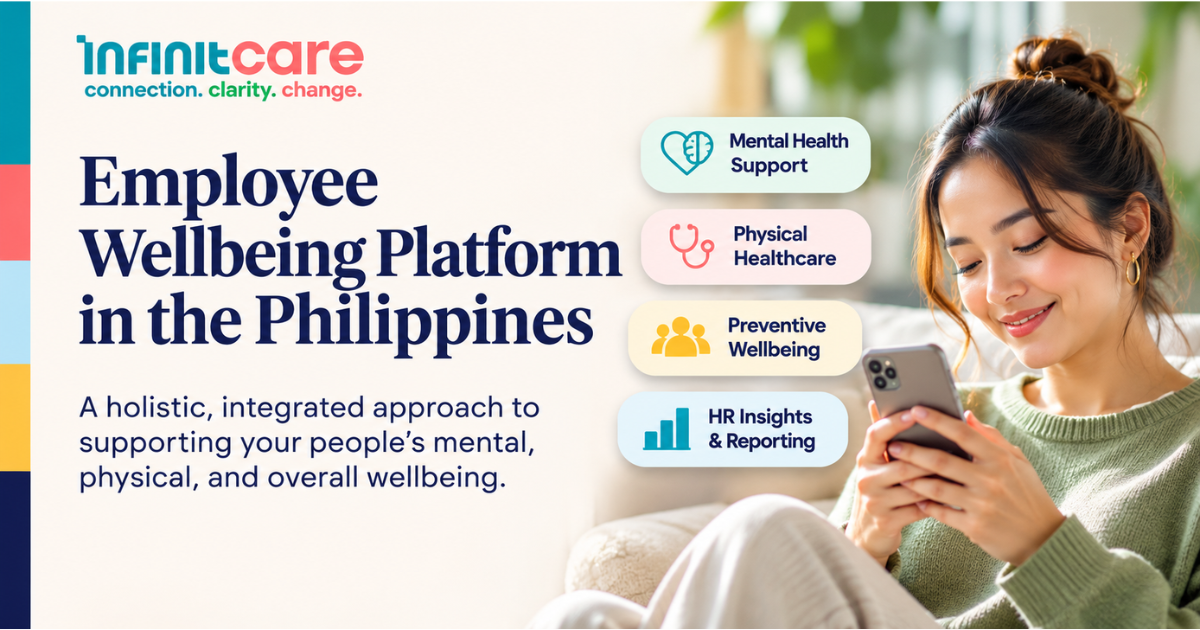
Employee Wellbeing Platform in the Philippines
A holistic 360-degree employee wellbeing platform in the Philippines helps organizations connect preventive health, mental health support, professional care, and employee engagement through one coordinated system. It gives employees clearer ways to access support while helping HR teams understand program participation and identify opportunities to improve workforce wellbeing. Technology-driven, the platform helps employers get better value from their HMO or healthcare program.
Infinit Care brings together preventive wellbeing tools, counseling, coaching, 24/7 Care Chat, physical healthcare services, workshops, and HR reporting in one employee wellbeing ecosystem.
Key Takeaways
- An employee wellbeing platform connects preventive care, mental health support, and physical healthcare instead of treating them as separate benefits.
- It can complement an organization's existing HMO.
- Employee access, confidentiality, professional qualifications, and reporting capabilities should be part of provider evaluation.
- Infinit Care combines digital wellbeing resources, professional support, healthcare services, and organizational programs.
- A successful program should measure more than app downloads. It should evaluate access, utilization, engagement, employee feedback, and agreed workforce outcomes.
- Data security is a cornerstone of a wellbeing platform.
Reviewing your organization's current wellbeing benefits? Talk to Infinit Care about your workforce's needs.
What Is an Employee Wellbeing Platform?
An employee wellbeing platform is a digital and service-based system that connects employees to resources and professional support for their mental, emotional, and physical health. It may include assessments, self-care tools, counseling, coaching, medical consultations, educational programs, and employer-level reporting.
The objective is to make support easier to find and access throughout an employee's wellbeing journey—not only when a concern has already escalated.
For employers, the platform can also help connect employee services with a more coordinated wellbeing strategy.
Why Do Employers in the Philippines Need an Employee Wellbeing Platform?
Providing benefits does not automatically mean employees know how to use them or feel comfortable asking for support.
An organization may already have an HMO, an EAP, and occasional wellness activities. However, employees may still be unsure where to go when they experience stress, personal difficulties, or physical health concerns. HR may also struggle to understand which services employees use and where additional support is needed.
This gap between available benefits and actual access is an important organizational concern.
The regulatory environment reinforces the need for employers to take workplace mental health seriously. DOLE Department Order No. 208-20 provides guidelines for implementing mental health policies and programs in the private sector. These include awareness and education, non-discrimination, confidentiality, access to treatment, referral systems, and supportive workplace arrangements. The guidelines also call for management and employee representatives to work together in developing the program.
Source: Department of Labor and Employment.
The scale of the issue extends beyond compliance. The World Health Organization estimates that depression and anxiety account for 12 billion lost working days globally every year, with an estimated annual productivity cost of US$1 trillion.
Source: WHO – Mental Health at Work.
For HR leaders, the question is no longer simply whether wellbeing benefits exist. It is whether employees can access appropriate support and whether the organization can evaluate how its program is working.
What Should an Employee Wellbeing Platform Include?
A well-designed platform should connect different forms of support based on employee needs.
| Capability | What it provides |
|---|---|
| Preventive wellbeing | Assessments, mood check-ins, self-care tools, and educational resources |
| Mental health support | Counseling, coaching, and access to Care Chat |
| Physical healthcare | Primary care, medical consultations, women's health, and nutrition services |
| Employee engagement | Workshops, webinars, and organizational wellbeing activities |
| HR insights | Program reporting, employee engagement trends, and wellbeing insights |
These capabilities should work together rather than operate as disconnected benefits.
For example, an employee may begin with a wellbeing assessment, explore self-care resources, and later decide to book a professional consultation. Another employee may benefit from a medical consultation or nutrition guidance. The right support depends on the person's needs and the services available under the employer's program.
How Does Infinit Care Work?
Infinit Care connects digital access, professional services, preventive wellbeing, and organizational support through one employee wellbeing ecosystem.
The experience can be understood through five stages:
1. Employee onboarding and access
Employees are introduced to the platform, available services, and the process for accessing support. Clear communication helps them understand where to begin and what to expect.
2. Wellbeing check-ins and assessments
Employees can use available assessments, mood check-ins, and self-care resources to reflect on their wellbeing. These tools can support awareness and help employees consider whether additional support may be useful. They are not substitutes for clinical diagnosis.
3. Access to appropriate support
Employees can explore available services such as counseling, coaching, 24/7 Care Chat, and physical healthcare services based on their needs and program coverage.
4. Continued engagement
Employees can return to wellbeing tools, access services, participate in workshops, or seek additional support as their circumstances change.
5. Organizational monitoring
HR teams can review available program-level reporting and insights to understand engagement and inform future wellbeing initiatives. Individual clinical information should remain protected according to applicable privacy requirements and the provider's documented data governance arrangements.
Employee Wellbeing Platform vs. EAP vs. HMO: What's the Difference?
These solutions serve different purposes. An employer may use them together rather than treating one as a direct replacement for another.
| Solution | Primary purpose | Considerations for employers |
|---|---|---|
| HMO | Access to covered medical services | Review coverage, provider networks, exclusions, and limits |
| Traditional EAP | Employee assistance, often including counseling and referrals | Review access methods, service scope, utilization, and referral arrangements |
| Employee wellbeing platform | Connects preventive wellbeing, professional support, healthcare services, and program insights | Review service integration, employee experience, confidentiality, and reporting |
The distinction is important: an employee wellbeing platform should not automatically be assumed to replace medical insurance or every existing assistance service.
For organizations with an existing HMO or EAP, the more useful evaluation is to identify gaps in access, prevention, employee engagement, and continuity of support.
How Do You Choose the Right Employee Wellbeing Platform?
Before selecting a provider, HR leaders should evaluate the following:
- Service coverage: Does the platform support both preventive wellbeing and access to professional care?
- Professional qualifications: Are the people delivering services appropriately qualified, and are referral processes clearly defined?
- Accessibility: Can employees access support across different schedules, locations, and work arrangements?
- Confidentiality: Can the provider clearly explain what information remains private and what information HR can access?
- Employee engagement: Does the provider support onboarding, communication, and continued participation?
- Reporting: Can HR understand utilization and program engagement through clearly defined measures?
- Implementation: Does the provider support program planning, employee communication, and ongoing evaluation?
For large organizations, these considerations are particularly important when supporting multiple departments, locations, and work schedules.
How Can Employers Measure Employee Wellbeing Program Results?
A successful employee wellbeing program should be evaluated through more than registrations or app downloads.
HR teams should establish a baseline and agree on measurable indicators before implementation.
| Measurement area | Example indicators |
|---|---|
| Awareness | Employee awareness of available services |
| Utilization | Employees accessing available services |
| Engagement | Repeat use and participation in activities |
| Access | Booking completion and service availability |
| Employee experience | Feedback and satisfaction |
| Wellbeing | Changes in agreed assessment indicators |
| Workforce outcomes | Absenteeism, retention, and other relevant organizational measures |
Infinit Care currently publishes the following platform figures on its website:
- 66% average employee utilization
- 90 Net Promoter Score (NPS)
- 11% reduction in absenteeism after program engagement
These are company-reported figures. Employers evaluating them should request the underlying definitions, reporting periods, sample sizes, client populations, and methodology. The absenteeism figure should not be interpreted as proof that the platform alone caused the reported reduction.
Source: Infinit Care.
Why Consider Infinit Care for Your Employee Wellbeing Program?
Infinit Care brings preventive wellbeing, mental health support, physical healthcare, and organizational programs together in one ecosystem.
Its current service offering includes:
- Preventive wellbeing: Wellbeing assessments, mood check-ins, self-care tools, and educational resources.
- Professional support: Counseling, coaching, and 24/7 Care Chat.
- Physical healthcare: Primary care, women's health, nutrition, and medical consultations.
- Organizational programs: Workshops, HR dashboards, reporting and insights, and workplace wellbeing initiatives.
For employers, this creates an opportunity to connect employee access to care with a more coordinated approach to workforce wellbeing.
The program should begin with an understanding of the organization's existing benefits, workforce requirements, and areas where employees experience difficulty accessing support. Services, communications, and engagement activities can then be aligned with those needs.
The goal is not simply to introduce another employee app. It is to make care more accessible and help organizations build a more connected approach to employee wellbeing.
Frequently Asked Questions
What is the best employee wellbeing platform in the Philippines?
The right platform depends on workforce needs, service coverage, professional qualifications, accessibility, confidentiality, and reporting capabilities. Employers should compare providers based on these requirements rather than feature counts alone.
How much does an employee wellbeing platform cost in the Philippines?
Pricing depends on employee headcount, selected services, professional support, implementation requirements, and program duration. Request a proposal based on your organization's actual requirements.
Can an employee wellbeing platform complement an existing HMO?
Yes. It can provide additional preventive wellbeing and professional support while the HMO continues to provide medical coverage under its plan. The scope of coordination depends on the employer's arrangements and provider agreements.
Is an employee wellbeing platform the same as an EAP?
No. An EAP generally focuses on employee assistance services, while a broader wellbeing platform can connect preventive resources, mental health support, physical healthcare, engagement activities, and organizational reporting. The actual scope varies by provider.
Is employee information shared with HR?
Providers should clearly explain their privacy policies, consent procedures, and reporting arrangements. Employers should understand the difference between confidential individual clinical information and appropriate program-level reporting.
Can small and medium-sized businesses use an employee wellbeing platform?
Many providers can configure programs for different workforce sizes. Availability and pricing depend on the provider's service model and the organization's requirements.
How long does implementation take?
The timeline depends on workforce size, selected services, onboarding requirements, communications, and existing workplace policies. Ask for a rollout plan with defined responsibilities and milestones.
Does an employee wellbeing platform guarantee DOLE compliance?
No. A platform can support access to services and workplace wellbeing activities, but employers remain responsible for developing and implementing the policies and programs required under applicable regulations.
Build a More Connected Employee Wellbeing Program
Your employees deserve access to support that goes beyond a collection of disconnected benefits.
Infinit Care helps organizations connect preventive wellbeing, professional support, physical healthcare, and organizational insights through one employee wellbeing ecosystem.
Let's look at what your current employee benefits provide, where the gaps are, and how a more connected wellbeing program could support your workforce.
Book a Discovery Call with Infinit Care